
Welcoming your baby into the world is a joyful and deeply transformative experience. As your child grows, each smile, sound, and movement becomes a cherished memory. However, it’s natural for parents to wonder if their baby is developing as expected. Understanding milestones of developments can help track progress and ease concerns about minor delays, if any.
Developmental milestones are age-appropriate skills and behaviors that most babies begin to exhibit as they grow. These include physical, social, emotional, language, and cognitive abilities such as sitting up, smiling, or responding to voices.
It’s important to note that every child is unique and will reach certain milestones at their own pace. Rather than comparing your baby to others, focus on steady progress across key areas of growth.
Understanding the various types of milestones helps parents support their baby’s overall development: physically, emotionally, and cognitively.
This includes raising the head, rolling over, crawling, standing, and eventually walking. According to the World Health Organization, most babies begin walking between 12 and 18 months, though variations are normal.
These involve early thinking and learning skills, like recognizing familiar faces, responding to names, and showing interest in toys.
Babies begin to engage emotionally by making eye contact, smiling at caregivers, and reacting to unfamiliar faces.
Communication begins through cooing, babbling, facial expressions, and simple words like “mama” and “dada.” Even in medically complex cases, such as those treated in our pediatric intensive care unit, language development is supported through responsive, caring interactions.
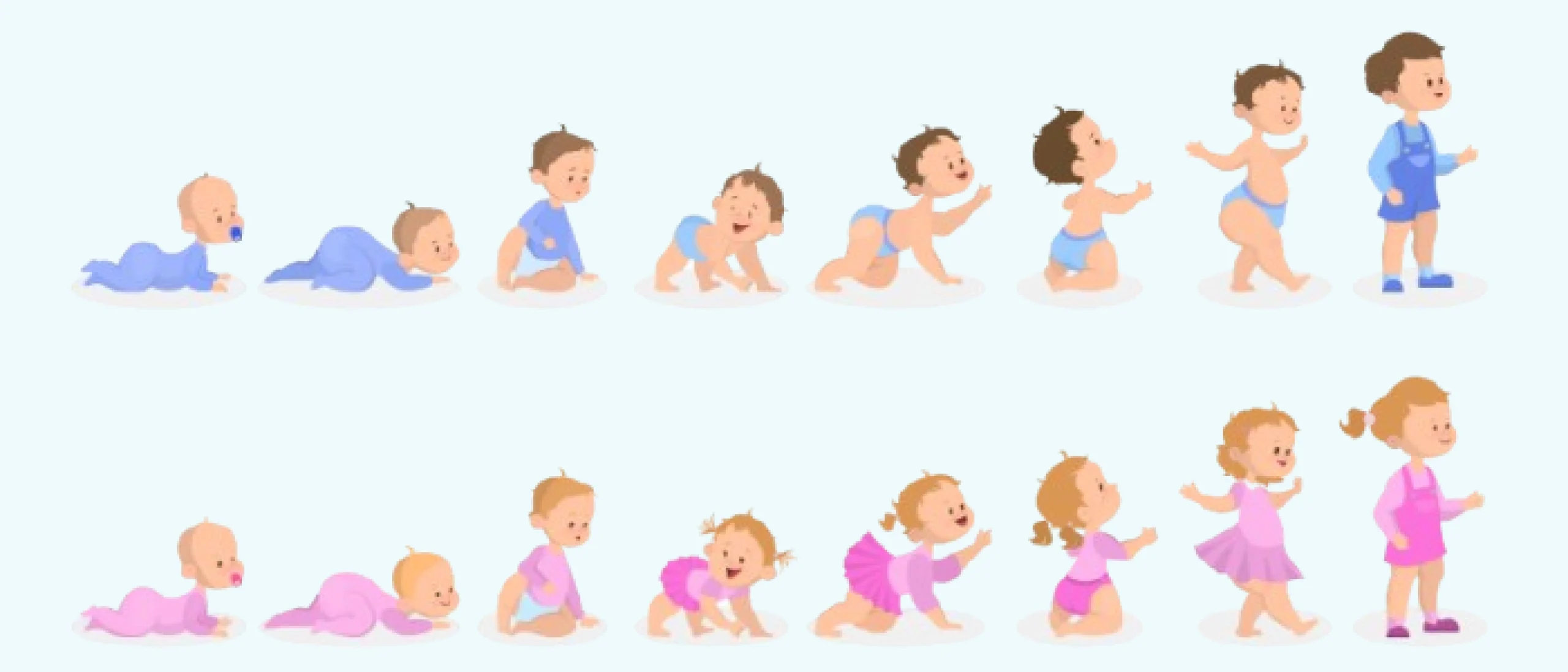
Here’s a brief overview of what most babies may achieve during the first six months of life:
|
Baby’s Age |
Developmental Milestones |
|
1- Month-Old Baby Milestones |
• Turns head toward sounds
• Briefly lifts head during tummy time • Begins strengthening neck and shoulder muscles • Focuses on faces • Shows interest in the caregiver’s face |
|
2- Month-Old Baby Milestones |
• Smiles as a response to any familiar voices and/or faces
• Begins social interaction • Coos and gurgles • Improves head control |
|
3- Month-Old Baby Milestones |
• Follows moving objects with eyes
• Lifts head and chest during tummy time • Recognizes familiar voices and faces • Expresses excitement through smiles or kicks |
|
4-Month-Old Baby Milestones |
• Pushes down on legs when feet touch a firm surface
• Begins rolling from tummy to back • Laughs aloud and mimics sounds • Explores hands and brings them to the mouth |
|
5-Month-Old Baby Developmental Milestones |
• Reaches for and grasps toys
• Rolls from front to back • Smiles expressively • Makes vowel sounds like “ah” and “oh” |
|
6-Month-Old Baby Developmental Milestones |
• Begins sitting with support
• Responds to their name • Transfers toys between hands • Shows curiosity about baby’s first solid foods |
During the first year, a baby’s brain grows rapidly. Regular conversations, singing, and reading aloud can significantly support brain development and build early communication skills.
Encourage:
While some babies may reach milestones early and others take more time, you should consult your pediatrician if your baby:
Parents may also notice common infant concerns such as cradle cap in babies, which is generally separate from developmental milestones but may still raise questions during early infancy.
According to UNICEF, nurturing care, such as touch, talk, and play, during the first 1,000 days significantly boosts brain development.
To support your baby’s growth:
These regular visits help monitor your child’s growth and ensure timely support when needed. At Dr. Mehta’s Hospitals, our expert pediatric care ensures comprehensive developmental support for every child.
If you’re concerned about your baby’s development or feel something may be off, don’t hesitate to consult a pediatrician. Early diagnosis and timely intervention can make a significant difference.
Parents of newborns may also have questions about conditions such as jaundice in newborns and when they should seek medical advice.
Every child follows a unique developmental path. While milestone charts offer helpful guidelines, your intuition as a parent is just as important. For any concerns, your pediatrician is your best resource. With love, attention, and timely care, your baby will continue to thrive.
1. My baby isn’t crawling at 6 months. Should I worry?
Not necessarily. Some babies crawl later, while others may skip crawling altogether and go directly to standing or walking.
2. How often should I take my baby to the pediatrician?
Typically, once a month for the first 6 months, followed by visits at 9, 12, and 15 months, unless otherwise advised.
3. Can milestone delays be temporary?
Yes. Minor delays are often temporary and many babies catch up naturally.
4. Are developmental delays always a sign of serious conditions?
No. Many delays are mild and improve with early support and engagement.
5. Where can I get some expert help for my infant’s development?
Visit Dr. Mehta’s Hospitals to consult with our experienced pediatric team for personalized guidance and support.
6. What are the common developmental milestones for babies?
Common milestones include smiling, holding the head up, rolling over, reaching for objects, sitting with support, and responding to sounds.
7. When do babies start recognizing their parents?
Babies begin recognizing familiar faces and voices during the early months of life.
8. When should a baby start holding their head up?
Babies gradually develop head control during the first few months, with steadier control usually developing by around 4 months.
9. Can talking to a baby help language development?
Yes. Regular talking, singing, and responding to sounds can encourage early communication skills.
10. What are the first milestones to look for in a baby?
Early milestones include smiling, making sounds, lifting the head, making eye contact, and responding to familiar voices.