

Many people notice knee pain while climbing stairs, even when walking on flat ground feels comfortable. This often raises a valid question: Is knee pain while climbing stairs an early indicator of arthritis?
The good news is that not all knee pain indicates arthritis. However, pain during specific movements like climbing stairs can signal that the knee joint needs attention. Identifying the cause early helps you take timely steps toward better joint health.
Knee arthritis is a condition characterised by gradual wear and changes in the knee joint. The knee joint has a smooth cartilage layer that allows bones to move easily. When this cushioning wears down, movement becomes less smooth.
The most prevalent form is osteoarthritis, which develops gradually over time. It can also occur earlier due to prior injury, excess weight, or repetitive stress on the joint.
Knee osteoarthritis is a common and serious health problem in India. It affects about 22% to 39% of people above the age of 40, making it one of the leading causes of knee pain and mobility issues in this age group.
Symptoms are often mild in early stages and may appear only during activities like climbing stairs or squatting.
The knee joint experiences greater pressure when climbing stairs than when walking on level ground. In fact, the knee can experience nearly three to four times the body weight while climbing stairs.
This added load can highlight early joint changes.
Common reasons include:
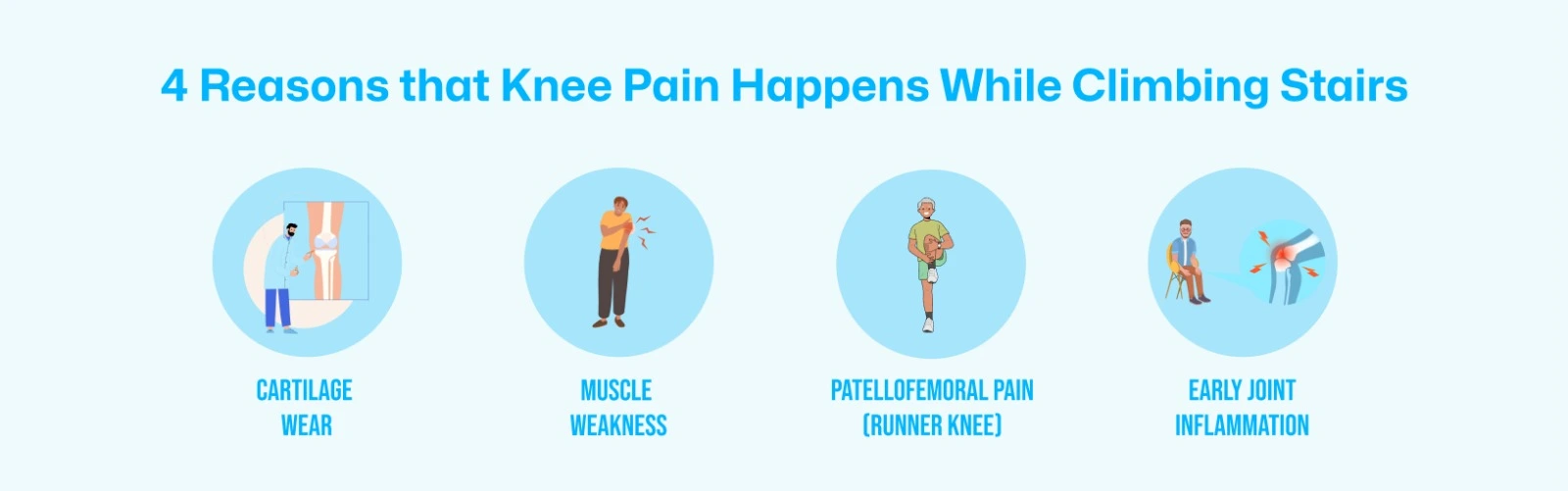
When cartilage cushioning reduces, the joint surfaces might not slide as easily. Stairs involve bending and weight-bearing, which may cause discomfort.
Weak thigh muscles can reduce knee support. This may cause strain during stair climbing.
Discomfort in the front of the knee, particularly when climbing stairs or sitting for long periods, can be associated with problems of the kneecap movement.
Mild inflammation can cause pain during movements involving deeper bending.
Medical assessment is necessary to know the exact cause, particularly when the pain persists, and Best lab services in Chennai can help identify the exact cause and guide appropriate treatment.
In some cases, yes. Knee pain while climbing stairs may be one of the first indicators of arthritis, especially when:
But the pain in the stairs alone does not rule out arthritis. Similar symptoms are also felt by many younger people as a result of muscle imbalance or overuse.
Studies have shown that osteoarthritis is quite common, with a prevalence of around 23.1% among adults in certain populations, highlighting how frequently such symptoms may be linked to underlying joint conditions.
Early assessment assists in distinguishing between simple strain and early joint changes. By assessing symptoms early, doctors can separate minor strains from early signs of joint damage, and with 24/7 emergency care available, urgent needs are addressed right away.
Not all knee pain behaves the same way. The location, timing, and age group often provide helpful clues.
| Condition | Pain Location | When It Hurts Most | Common Age Group |
| Early Arthritis | Deep inside the knee | Climbing stairs, squatting | 40+ |
| Runner’s Knee | Front of the knee | Stairs, sitting long time | Young adults |
| Ligament Strain | Around joint | Sudden movement, twisting | Any age |
| Meniscus Concern | Inner or outer knee | Turning, bending | Adults |
Key Differences
This comparison helps identify patterns, whereas professional assessment makes the diagnosis precise.
Occasional mild pain may improve with rest and strengthening exercises. Nevertheless, medical consultation is recommended in case:
Early medical consultation helps manage symptoms before they affect daily life.
Doctors may recommend:
Early intervention helps to achieve greater comfort in the long-run. Early treatment at a leading ortho hospital in Chennai can reduce discomfort and safeguard long-term joint health.
Simple habits can help you if you have mild stair pain:
Minor regular adjustments can have a significant impact.
Knee pains while climbing stairs may indicate early arthritis, but not always. Similar symptoms may be caused by a number of conditions, particularly muscle weakness or problems with the alignment of the kneecap.
What matters is not ignoring persistent discomfort. Early assessment and some simple lifestyle changes can help maintain joint comfort and mobility over time.
To keep your knees strong and functional in daily life, it is important to listen to your body and seek medical advice when needed. Connect with our expert doctors to evaluate your symptoms and plan the right care.
No. It may be due to muscle weakness, kneecap alignment, or mild strain.
It is more common after 40, but can occur earlier depending on lifestyle and injury history.3. Can exercise help reduce stair pain?
Yes. Strengthening thigh muscles can improve knee support.
Not necessarily. Moderate use is usually safe unless pain is severe. Your doctor can guide activity levels.
Mild swelling may occur, but may not always be present.
Yes. Even a small weight reduction can reduce stress on the knee joint.