Did you know that 60–80% of newborns in India develop jaundice in their first week of life? If your newborn’s skin looks yellow, you’re likely worried, and that’s completely normal. The yellow tint can be alarming for any new parent, and the fear of the unknown makes it even harder. (source: National Institute of Health)
But here’s the good news: in most healthy babies, jaundice is temporary, manageable, and goes away on its own or with simple treatment. This guide will walk you through everything you need to know, what causes it, how to spot it early, and what doctors actually do to treat it.
By the end of this article, you’ll know exactly when to worry, when to wait, and how to support your baby’s recovery.
Neonatal jaundice is a condition in which the skin and the whites of the eyes of a newborn assume a yellow appearance because of increased bilirubin in the blood. Bilirubin is a natural substance formed when red blood cells break down.
Newborns have not yet fully developed their liver, which is involved in the breakdown of bilirubin, so there is a temporary effect of increasing levels of bilirubin.
Not all newborn jaundice is the same. Knowing the type helps parents and doctors decide the right course of action.
| Type | When it appears | Main Cause | Severity | Typical Treatment | Resolves in |
| Physiological –
(Most common type) |
Day 2–4 after birth | Immature liver; normal red blood cell breakdown | Mild | Monitoring + frequent feeding | 7–14 days |
| Breastfeeding jaundice –
(Early onset) |
Day 2–5 after birth | Poor milk intake; infrequent feeds slow bilirubin clearance | Mild – Moderate | More frequent feeds (8–12/day); lactation support | 1–2 weeks |
| Breast milk jaundice –
(Late onset) |
After day 7 | Substances in breast milk slow bilirubin breakdown | Mild | Continue breastfeeding; monitor bilirubin | Up to 3 weeks |
| Pathological –
(Requires urgent care) |
Within first 24 hrs | Blood group incompatibility, infection, liver conditions | Severe | Phototherapy, IV fluids, exchange transfusion | Varies, under close monitoring |
Newborns get jaundice because their bodies produce more bilirubin than their liver can handle at birth.
When red blood cells break down, they release a yellow pigment called bilirubin. A newborn’s liver is still developing and cannot filter this bilirubin fast enough, so it builds up in the blood and shows up as yellow skin.
There are three simple reasons this happens in babies specifically:
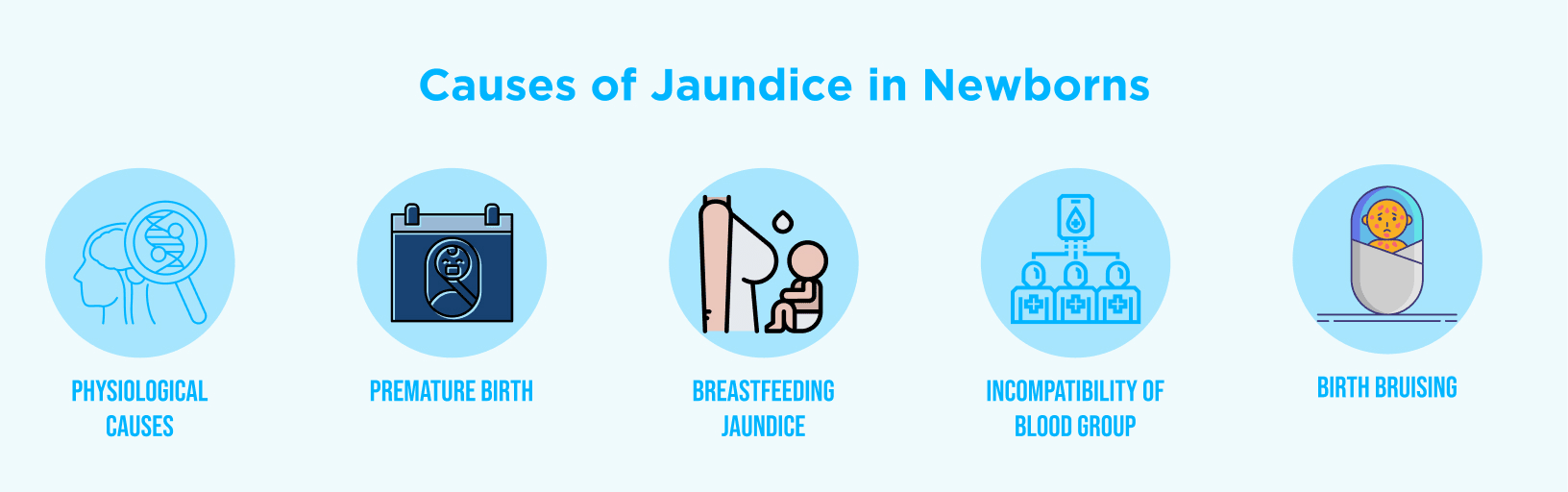
Here are some causes of jaundice in newborn:
The symptoms of jaundice in newborns are not difficult to notice:
Warning: When to Act Immediately
If your baby shows jaundice within the first 24 hours of birth, has a high fever, is extremely difficult to wake, is arching their back, or has pale stools, go to the hospital immediately. These may signal serious underlying conditions.
When you see these symptoms of newborn jaundice, visit a paediatrician immediately. Choosing the right child specialist early on helps parents feel confident about managing newborn health concerns. To get the best possible neonatal jaundice therapists, visit the best paediatrician for newborn care.
It is necessary to diagnose jaundice in newborns early to prevent the development of complications. During birth and the initial days, the doctors pay close attention to the yellow color of your baby’s skin, gums, and eyes. Diagnosis may involve:
Newborn screening in the first 24–48 hours lets doctors act early and prevents most mild cases from becoming serious. so the level of jaundice in a newborn can be corrected early, and parents will be relieved that their baby is doing fine.
According to a study conducted at SMS Medical College in Jaipur, about 60% of full-term newborns and up to 80% of preterm babies develop neonatal jaundice in their first week of life.
Doctors may recommend new born baby jaundice treatment such as phototherapy, increased feeding, or medical monitoring depending on bilirubin levels.
Newborn jaundice is treated based on the level of bilirubin, age of the infant, and cause of jaundice:
A note on sunlight: Many families in India try placing babies in indirect sunlight as a home remedy. While it may have some mild benefit, it is not a substitute for phototherapy. Direct sunlight can cause sunburn and overheating. Always follow your doctor’s advice before trying this.
The answer is both depending on the situation.
In the early days, if your baby isn’t latching well or feeding often enough, they may not get enough milk. Less milk means fewer bowel movements, which slows bilirubin elimination. This is breastfeeding jaundice and it’s the reason feeding frequency matters so much in the first week.
Once feeding is going well, breast milk actively supports recovery. More frequent feeds improve hydration and digestion, both of which help clear bilirubin faster.
In almost all cases, the recommendation is to continue breastfeeding and not to stop. Aim for 8–12 feeds per day. If you’re struggling with latch or supply, a lactation consultant can make a significant difference.
Many parents ask how many days it takes for jaundice to recover in newborn babies. In most healthy full-term babies, jaundice usually improves within 7 to 14 days.
In premature babies, recovery may take 2–3 weeks depending on bilirubin levels and treatment.
Jaundice in newborns can seem worrying to parents, but it is usually temporary and manageable.. Most babies can recover within a short time with timely diagnosis, gentle monitoring and effective treatment options such as phototherapy, hence they continue to thrive. The most important thing is a timely response and constant monitoring by skilled medical treatment specialists. Alongside newborn care, staying updated with essential immunizations ensures that babies remain protected against preventable diseases.
Our team at Best Super Multispeciality Hospital in Chennai brings a distinct mixture of competence and caring to help parents through all the steps of the procedure, so your baby is provided with the safest and best beginning in life. As a team, we guide your baby through the jaundice recovery time newborn process to a healthy glow with confidence.