

Difficulty moving freely or persistent hip pain can gradually affect walking, sitting, and participation in social and family life. When conservative treatments no longer provide relief, surgery may become the next step. At this stage, many patients find themselves comparing hip resurfacing vs hip replacement to understand which option aligns best with their age, activity level, and long-term mobility goals.
Both procedures aim at comfort and mobility enhancement despite differences in the mode of operation, recovery and long-term concerns. Understanding these differences helps individuals make informed decisions based on their lifestyle, activity level, and long-term health goals.
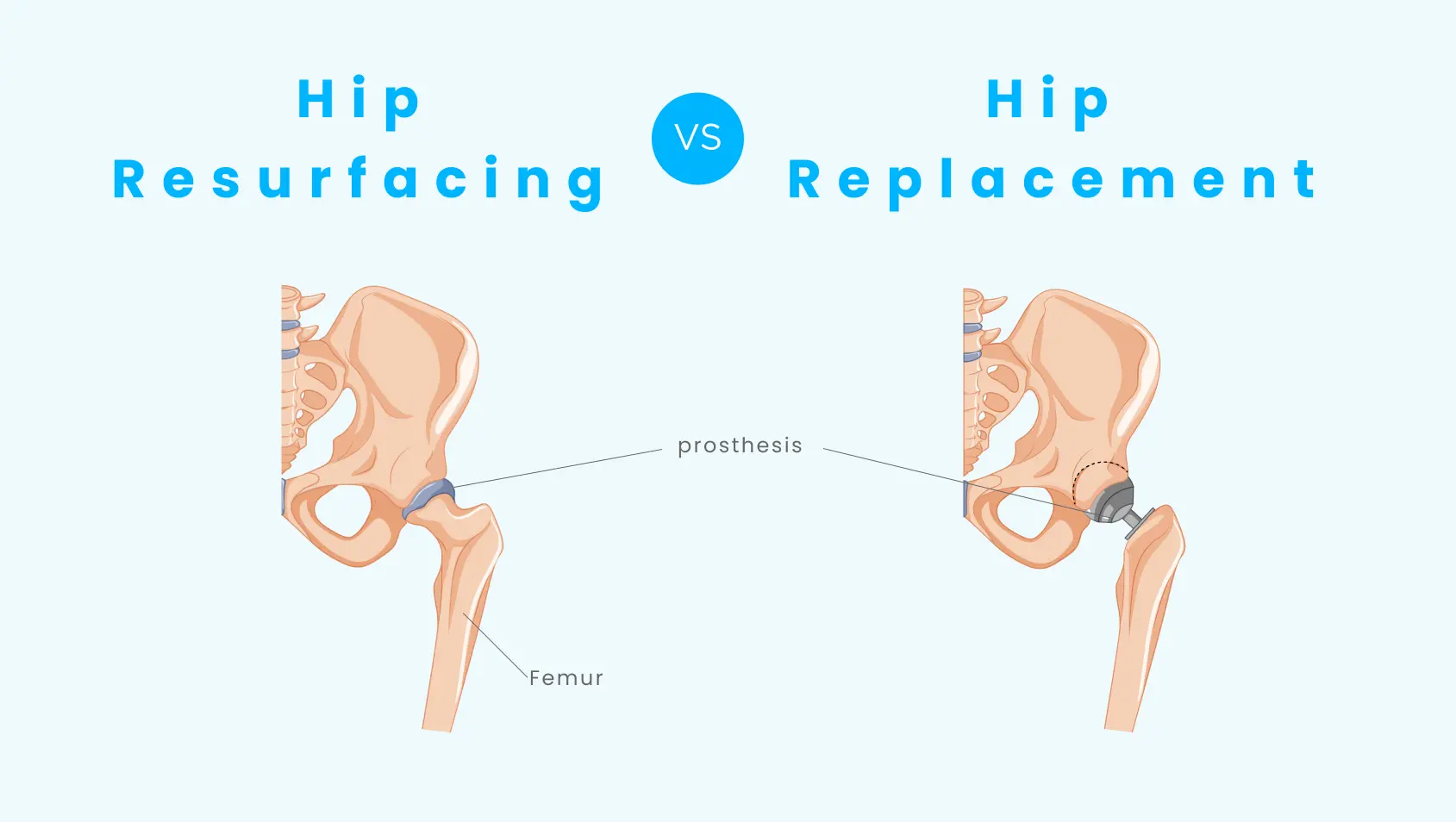
Hip resurfacing is a bone-preserving surgical procedure that reshapes the damaged surface of the hip joint and covers it with smooth metal caps. Compared to total hip replacement, significantly less natural bone is removed.
Hip resurfacing surgery in India shows strong success rates, often reported between 90–95%, with favourable long-term outcomes in appropriately selected patients It goes well, especially with younger and active men, and it is long-lasting, just as is the case with the top countries in the world. While procedure-specific national data is limited, broader hip replacement statistics indicate that approximately 75,000 hip surgeries were performed in India in 2022.
It is a technique that is often suggested to individuals who are physically active and have good bones. By preserving more of the natural joint structure, hip resurfacing may support higher activity levels over time, subject to medical guidance and rehabilitation.
Total hip replacement involves replacing the damaged hip joint with artificial components, including a ball and socket.. This is a process that has already taken decades and has a track record of bringing comfort and mobility.
It is usually administered to patients with severe joint changes, deteriorated bone quality, or persistent soreness impacting daily life. Total hip joint replacement in Chennai restores joint mobility and relieves pain, allowing individuals to return to daily activities with improved confidence.
The two procedures are aimed at the improvement of the quality of life, and the difference between the two is in the technique, recovery chances, and suitability. In order to value the differences between the two choices, the table below brings out some of the differences.
| Feature | Hip Resurfacing | Total Hip Replacement |
| Procedure Type | Preserves most of the natural hip bone by reshaping and capping the joint | Replaces the damaged hip joint with artificial components |
| Bone Preservation | More bone is preserved | More bone is removed |
| Ideal Age Group | Often considered for younger, active adults | Suitable for a wider age range |
| Activity Level After Recovery | May support higher activity levels with guidance | Supports comfortable daily movement and low-impact activities |
| Implant Size | Uses a larger joint surface | Uses smaller artificial components |
| Future Surgical Options | Allows easier conversion to total hip replacement if needed | Revision surgery may be more complex |
| Recovery Focus | Gradual return to strength and flexibility | Emphasis on pain relief and functional mobility |
Hip resurfacing may be suitable for individuals who:
Suitability should be determined through consultation with an orthopedic specialist after a detailed clinical and imaging evaluation.
In India, tens of thousands of hip replacement surgeries are done annually, with a success rate of between 90 and 98 percent. Total hip replacement may be considered for individuals who:
It is commonly recommended when comfort, stability, and reliable movement are the primary goals. After recovery, most individuals are able to return to normal daily activities with improved ease and confidence.
Choosing between hip resurfacing and total hip replacement involves more than just selecting a surgical technique. An in-depth consultation with the top orthopaedic expert in Chetpet will be helpful in making sure that the decision is appropriate.
Some of the critical factors to address are:
These are some of the factors that many people find helpful when undergoing systematic orthopaedic checkups, with imaging and clinical examinations informing personalised prescriptions.
Hip resurfacing and total hip replacement are both effective surgical procedures that aim to make the hips more comfortable and mobile. At Dr. Mehta’s Hospitals, the decision varies with personal health, bone health, activity levels, and long-term lifestyle objectives.
Hip resurfacing may be suitable for individuals seeking a bone-preserving option that supports higher activity levels. In contrast, total hip replacement is a more proven solution that deals with certain movement and comfort in daily life. Having the help of the professional orthopaedic team, the person will be able to make a decision that will be helpful to their current health condition and their future well-being. Consulting an experienced orthopedic team helps ensure the most appropriate treatment choice and long-term joint health.
Neither option is universally better. The choice depends on age, activity level, bone quality, and individual health needs.
Recovery varies by procedure and individual. Most people gradually resume daily activities over several weeks, with guided rehabilitation.
Many individuals return to walking, daily tasks, and light exercise. The surgeon and physiotherapy plan guides activity levels.
Hip resurfacing is not suitable for all individuals. Bone quality and overall health play an important role in determining suitability.
A detailed discussion with an orthopaedic specialist, along with imaging and health evaluation, helps determine the most suitable option.